“Things that are equal to the same things are equal to each other”
"Things that are equal to the same things are equal to each other."
I recently came across this quote by Euclid, and it really resonated with me as it relates to the work I do around equity. When Euclid wrote this first "Common Notion" in Elements over 2,000 years ago, he was defining a fundamental law of mathematics and logic. But if you look closely at the core philosophy behind human rights, social justice, and advocacy this ancient axiom serves as a perfect blueprint for equity, diversity, and inclusion.
Now, anyone who knows me knows I am generally not a scientific or mathematical person (although I did get an A in my Astronomy 101 course last year). Still, I feel that this mathematical logic ties nicely into the work I do through Fostering Diverse Communities Canada.
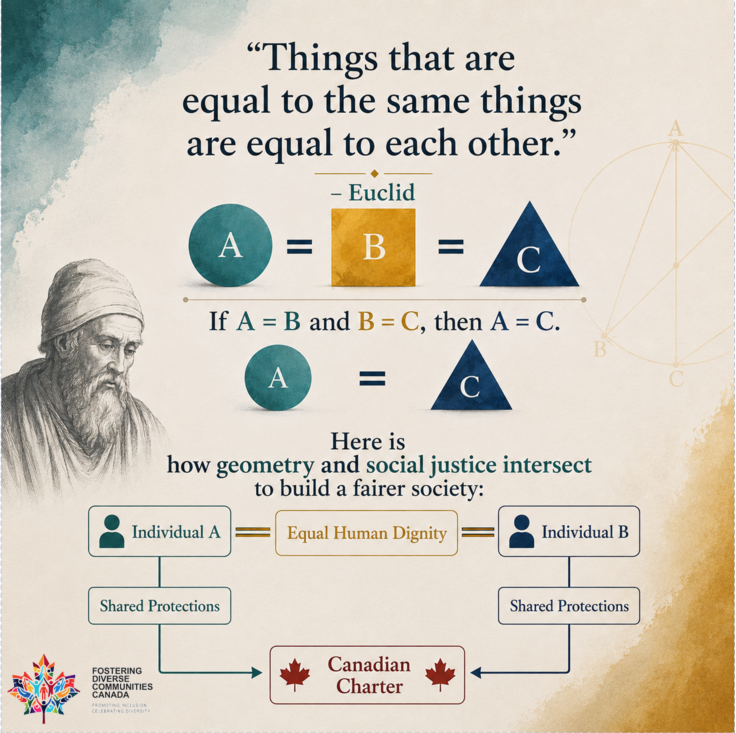
In mathematics, this property is known as transitivity. If A = B and B = C, then A = C.
If we translate this into human terms:
Individual A is equal to the foundational standard of human dignity, respect, and rights.
Individual B (regardless of their background, ethnicity, gender, identity, or origin) is equal to that exact same standard.
Therefore, Individual A and Individual B are entirely equal to each other.
Equity work is not about making everyone the same; it is about recognizing that our baseline value is identical. "Things that are equal to the same things are equal to each other." No matter how different two people's lived experiences are, their shared connection to the fundamental right to belong makes them equal peers in our society.
Fostering Diverse Communities Canada strives to build communities where individuals from all walks of life share equal access to opportunities, safety, and respect.
When systemic barriers discriminate against a specific group, it breaks Euclid's equation. It suggests that the standard of dignity applies to some, but not to others. True inclusion means fixing the equation so that the "Common Notion" of human worth applies universally across schools, workplaces, and neighborhoods.
Euclid considered his common notions to be self-evident truths that required no proof. They were simply the starting point for everything else.
In the same way, human equality should be a self-evident starting point for how we structure our communities. Inclusion is not a specialized favour or a secondary goal. It is the fundamental framework required to build a harmonious, prosperous, and cohesive society.